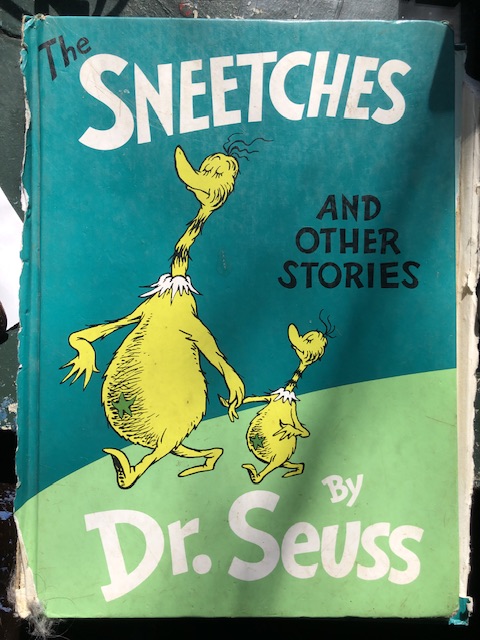
Pity the Sneetches without stars on their bellies. They are excluded from the company of the Sneetches with stars, who walk around all snooty and smarty, not inviting them to their frankfurter parties. Then Sylvester McBean arrives with a fix: a “Star-on” machine, which allows them to associate with their star-belly brethren. They are naturally incensed. McBean addresses their angst with a “Star-off machine,” and pretty soon all the Sneetches are running through each machine every few minutes in an effort to keep up, until they are bankrupt. McBean drives away with all their money, yelling, “You can’t teach a Sneetch!”. But in Dr Seuss’s tale, the Sneetches do learn their lesson and live in harmony afterward.
We writers aren’t as smart as the Sneetches. Silicon Valley stole our copyrighted material to create writing algorithms that are convincing enough to blur the lines between human-generated work and AI. Just like McBean, they “fixed” it by creating an “AI detector”—Pangram and others. And just like McBean, they addressed the “AI detector” by selling us an “AI detector-fooler”, called a “humanizer” in some circles.
Are we going to act like Sneetches, sending all our money to the AI overlords in a continuous AI/AI detector/AI fooling loop until we are broke?
Here’s another way. The reason Pangram can get away with what is essentially a shakedown (nice manuscript you have there kid, be a shame if somebody labeled it AI) is that the term is a bogeyman, completely undefined. Depending on who you talk to, it can range from using spell check to having an LLM create an entire story based on a prompt. What does it mean for Pangram to label something “31% AI?”
To fix this, and stop Pangram in its tracks, I propose much more granular self-disclosure and labeling of content, along the lines of FDA content rules for food. We all buy different kinds of food–prepared, processed, fresh, organic, and we trust that food because we trust the labeling. There is a range to AI which a facile “31%” does not describe. Off the top of my head, from least to most, I would create a ranking like this:
Spell/grammar/syntax/checkers
Non-generative Copy and line Editing tools that identify weak prose but do not change the text—use of passive tense, awkward construction, run-on sentences, overuse of adverbs, repeats
Generative Copy and line Editing tools that act as above but also suggest alternative prose/language. (Personally, this is where I draw the line; I am fine with anything an editor would flag, e.g., “that sentence is passive”, but I will never accept a rephrase from a program.)
Structural editing tools that identify plot holes and weaknesses—again, this would be divided into generative and non-generative use.
Researching: this is a gray area that I am wary of using myself; I have seen “research” output that would be very easy to turn into prose, but I am not judging anyone who uses it
At the far end of the scale, pure generative AI where a story is created by a prompt.
This scheme could be based on voluntary disclosure, just like the grocery store. It could be coupled with penalties for abuse, in both directions: non-disclosure of use of a category, and also defamation –accusing a writer of using AI without proof (looking at you, Pangram).
Besides the food industry, there is precedent for a standards-based, self governing body setting defined protocols– the computer industry. It uses “RFCs” (Requests for Comment) which define interfaces and routines, all voluntarily reached by consensus of an industry group.
The alternative is to let Silicon Valley control us, with AI, AI detectors, AI detector-foolers, and so on. Let’s let them know we are not Sneetches, and we aren’t going to play their game.
We took our fourth child off the machines to let him die when the doctors told us he would never change. He had been born way too early and suffered severe brain injury, to the point that he just had basic autonomic functions, no brain activity. “He is just operating on his brain stem,” they said. “It’s cruel; he coos and gurgles like a normal baby, but he will be doing that when he’s 70.”
I am reminded of that conversation now that my mother has come to live with us. She is 88 and suffers from dementia. Every day with her is like that baby that died long ago; the same thing, with no hope of change. “What day is it?” “Tuesday.” Five minutes later, “What day is it?” a hundred times a day. The same with a dozen other questions, repeated at intervals though the day.
My mother’s dementia is especially cruel because in other ways she presents perfectly normally, like our long-dead son. She is very sharp and can hold a conversation on a subject that doesn’t require memory perfectly well, so much that it is easy to forget the dementia. Until, in another five minutes, the question, the one that has been answered a dozen times that day.
Also like caring for a brain-damaged child, caring for a parent requires near-superhuman reserves of patience. “What day is it?”
“TUESDAY” I want to scream. “It’s fucking Tuesday like it was five minutes ago! TUESDAY TUESDAY TUESDAY” I want to pound the walls. Scream. But I don’t. I just capture the image of when I was helpless and entirely at the mercy of her love and care, when I was the infant and demanded the same things from her, again and again and again, until I am sure she wanted to scream and pound the walls. But she didn’t.
“Tuesday, Mom. It’s Tuesday.” It will always be Tuesday, here in my house.
An oil baron lives in a mansion filled with stuffed dead animals and a barely living cat, which he dotes over. Receiving word of the dangers of drilling in Alaska and Greenland, he dismisses his engineer’s concerns with a “drill, baby, drill” mantra. It is only when the Greenland site blows up, sending a chunk of ice the size of Rhode Island toward Europe, where it will cause flooding that will kill hundreds of thousands, that he even shows concern—over his drilling rig. He quickly calls the President of the United States, who he has on speed dial and whom it is apparent that he controls. Another day in the life of an oil mogul? Nope, this is the setup for “Digger”, a farcical satire starring Tom Cruise and John Goodman doing their best to out-ham each other.
To explain this movie, and why I think it is worth seeing, I need to reveal two spoilers: The first is we are watching a play, which doesn’t become evident until Digger (Tom Cruise) misses a line in a scene with the president (John Goodman) and they break character, and the camera rolls back to reveal the set, with stagehands running around setting the scenes. So far, so Adam McKay, he of “Don’t Look Up” fame, a transparent, tone-deaf screed about global warming. The second spoiler is more subtle and jarring. For reasons never made clear, the rogue iceberg is named “Judy” and in a scene of the play within the movie, a character mentions “Judy” like it was a real event in their world, not in the play. What?
The big reveal is that the play is in fact a comedy satire, but not of the Adam McKay warning variety—it recounts historical events where the Digger character and the President ended up on Air Force One and destroyed another, bigger iceberg, which unleashed both radiation and flooding that didn’t quite destroy the world, but almost.
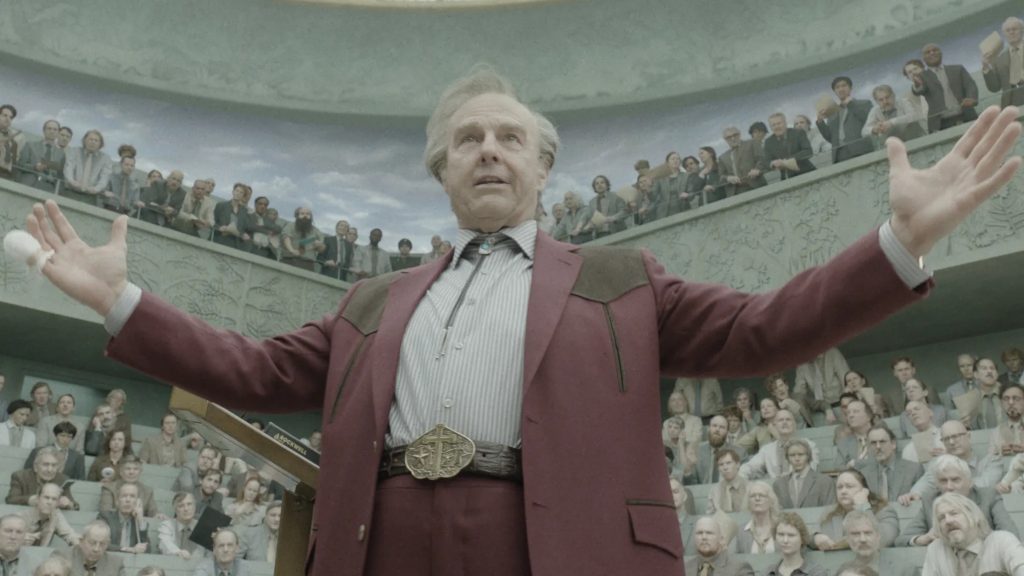
There are two great monologues in this movie. The first is Tom Cruise’s Digger, in a speech to a cage match of a United Nations where he admits that he enriched himself beyond measure by drilling for oil, but in a scene of uncharacteristic self-reflection for an Adam McKay type movie, he points the finger at them. You hypocrites, he rails. Oil has given you the easy life where you can overnight-order crap you don’t need, live in air conditioning, and travel where your whims dictate. How many of you bicycled or walked here? he asks. I cheered at the character in the scene. I am so tired of listening to sanctimonious NPR and PBS hosts natter about “human-caused global warming”. First of all, there is a correlation between CO2 and a warming climate, but not a causal one. Second, if they really believed CO2 were the cause of the warming, why would they live such profligate lives? I would bet every single one of the presenters blabbering about “human-caused global warming” has a CO2 footprint one hundred times mine: I live in a small house that is easy to heat; it costs about $400 a winter in West Virginia for heating bills, with no air conditioning. Digger’s speech, taking these “limousine liberals” to task for flying private jets to climate control conferences (I’m looking at you, Al Gore) is the reason that this movie has been panned and damned with faint praise by the intelligentsia—it hits the hypocrites of the global warming fear-panderers too close to home.
The second great monologue is Jesse Plemons, who portrays the play’s producer. He intervenes when the character playing Digger in the play (Tom Cruise) has a row with the play’s manager. “You’re both right. But we need to set this aside and get on with it.” He is talking about the play, but he is actually talking to both sides of the current global warming debate. “It doesn’t matter who’s right, he pleads. I just want the play to go forward.” Likewise, the Earth is experiencing dramatic weather changes regardless of whether, or to what extent, they have been caused by human-produced CO2, and we need to deal with it anyway. Another reason the movie won’t do well, I think—nuance and balance don’t play well these days.
The movie’s ending is nothing less than shocking. There are intimations that the events depicted in the play have changed the climate, but these don’t prepare you for the ending. The penultimate scene is right out of any West End or Broadway night, actors slapping each other on the back, taking bows to the audience, who are cheering madly. But as the camera pans to the audience, they are shown sweating copiously. An alarm sounds, everyone dons breathing masks, the door opens,and they exit into a hellhole of a New York that makes the Blade Runner set look like a tropical paradise. This is the world we have wrought—not just Digger, but all of us.
I really enjoyed this movie. Cruise’s monologue to the barbaric-UN is worth the price of admission alone. There are a few monologues that I loved so much I memorized—Henry V’s speech before Agincourt is one, Tony Montana’s drug-addled restaurant rant in Scarface is another. This might be a third.
Authors get tons of scam emails. Some are pitiful in their ineptitude and transparency, often originating from an email address like “famousagentreallyimnotmakingthisup@gmail.com.” Those remind me of that Super Bowl FedEx ad, the one where the space alien puts a human paper mask over his face, and everyone believes him because he keeps saying “Let’s use FedEx”. Scams are getting better with AI now. Most of them rave about how good your book is and seem to come from someone who actually read it. And some aren’t scams; they are people trying to sell you a service which may or may not be worthwhile. I have bought a few of those and got what I paid for.
My most interesting interaction was with a gang member, a smuggler, whom I ran into during my research for Hotwire. He texted that he wanted to kill me and sent photos of his handiwork, kind of like how remodelers will send pics of bathrooms and kitchens they have worked on. Except these were pictures of dead bodies, which he promised I would look like soon. Not just me, my entire family–he also listed my wife, kids, and their spouses on the “to be killed” list- including my daughter’s two ex-husbands! I wanted to reach out to the guy to help him in his nascent career as an extortionist. “You don’t need to threaten me! I would pay you good money to kill a few of the people on this list!”
But I didn’t, because the first rule in dealing with a scammer is never to respond. Which brings me to last month when I got a most contrived and obviously scammy email—a woman in the UK wanted to buy an original copy of Hotwire, the original cover with Lady Liberty slammed over an ICE cruiser, the one I retired because I thought it stifled sales. Money was no object. She had gotten a copy from a friend, another woman, who had loaned the original to her, and she had lost it. Obvious scam! First of all, all the women I know in the UK will not talk to me anymore. But in a conversation, she mentioned her friend’s name, whom I did know, and for reasons unknown, is still talking to me. So I sent her an email to arrange funds transfer, shipping. Etc. And heard nothing for two weeks, confirming my initial suspicions. Pretty elaborate for a hoax, I thought.
So it was a surprise to get another call from her two weeks later; my email had gone into the “bit bucket”, she was legit, and the crazy story of a lost book and a woman still on speaking terms with me was true! Book sent and funds transferred in short order.
I think there is a lesson there about trust and the lack of it today. Most people I know will not answer a call with an unknown number—a far cry from a time when all our names, numbers, and addresses were listed in a book which doubled as a booster seat, distributed each year. Nowadays this would be called doxing. I got the initial email while eating lunch at WriterCon in OKC and asked my lunchmates what they would do—every single one of them, about a dozen, said they would never have responded to the first email.
We have lost something to these scammers. I don’t know how to regain it, but I want to live in a world where I can trust people. I think you create the world you live in by your actions, so I will continue to respond to the odd email, phone call, and text. But I’ll try to avoid the gang members (even though, as a pretty good author, I think I could really up their extortion game.)
Megga Maps update: No battle plan survives contact with the enemy, and no draft survives contact with a beta reader! Still revising, shooting for ARC out by 1 November.
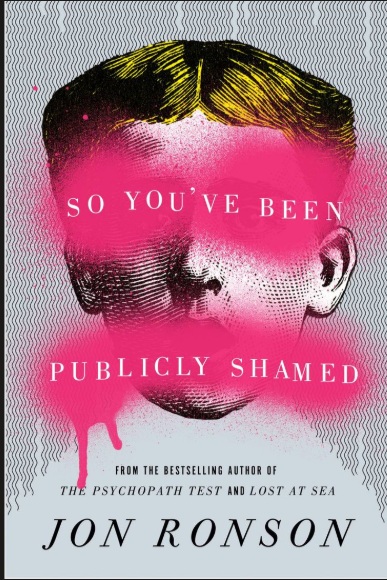
This book confused me at first: I expected it to address the pernicious aspects of current internet-era shaming (and it does, eventually), but the first chapter is about the author’s experience of identity theft, in which internet shaming actually helped him. For reasons that remain unclear, three academics created a bot with his name that evinced all kinds of crazy opinions online, most related to food choices. When he contacted them, they were unrepentant: “You don’t own the name”, was their response. So he invited them to a meeting which he recorded and put online, showing them to be the bumbling idiots they were. They quickly scurried back under the rock from which they came.
So, shaming works, and is good, right?
In that case maybe, but Ronson goes on to cover a number of cases where internet shaming destroyed lives, some where the shames were unaffected and got off scot-free, some where the victims were ultimately redeemed, and one where the attacker was shamed herself and ultimately destroyed her own life. Along the way, we meet a fellow in LA who promises to inure people to malicious tweets, chiefly by having them yell at each other, charging $600 for the privilege. It was entertaining, but seemed to be a collection of vignettes without a common theme. I was expecting a “unified theory of shaming” but never got one. Except, perhaps, if you are going to be internet shamed, it seems much better to be a man. A fellow who lost his job because he was overheard making juvenile jokes about “dongles” quickly got another one, but the woman who attacked him was subsequently shamed herself, lost her job, and (as of the book’s writing) had not found another. The woman who played a childish prank at a veteran’s cemetery became public enemy #1 for vets, up there with Jane Fonda. She was ultimately redeemed by a company, documented in the book, that “unshames” you by putting out so much anodyne pap that the nasty stuff is relegated to page 2 of Google lookups. The (in)famous case of the woman who made an unfortunate tweet about Aids in Africa was covered; her life took a long time to return to normal. Whereas the Head of Formula 1 racing is filmed participating in a German military-themed sex orgy and no one cares. Ditto for a Pastor who has a tryst with a hooker and is subsequently revealed to the community.
It is a fun, fast read about the modern era and has some good background history about public shaming—apparently it was a viable punishment up to the 1800s—and also has a good teleological discussion of shaming in modern criminal correction. So I was entertained and learned something. 4/5 stars.
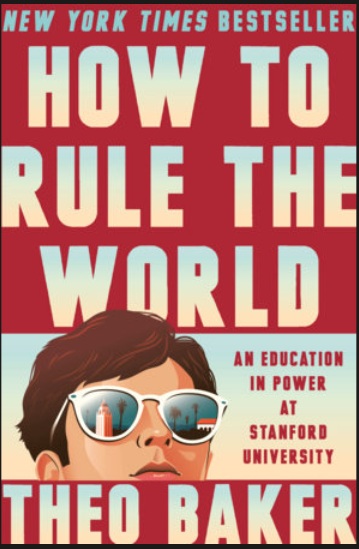
Theo Baker must need a wheelbarrow to carry his testes around; I cannot imagine him standing up to Stanford as he did at any time, much less as a 17-year-old freshman. “How to Rule the World” is both a memoir of his freshman year and a dissection of the amorality that plagues his alma mater, told through the lens of his investigative reporting on the college newspaper (Stanford Daily). As a freshman reporter, he investigated and published reports about irregularities in the university president’s research into Alzheimer’s while that man was a scientist at Genentech, which led to his resignation.
The book jumps between scenes of campus life post-pandemic, post-MeToo, and apparently post-fun, juxtaposed with accounts of him tracking down a lead, interviewing contacts, being threatened by the president’s lawyers, and ultimately being vindicated. The dual narrative is choppy in spots, but the story does not drag and toward the end I read the rest of the book in a 5-hour sitting; it was that gripping.
That’s the external story of the book. The internal story is about a university that has become rich and sated, grown into a juggernaut with cash reserves larger than most nations, and along the way has lost its soul. Scenes abound in the book of undergraduates offered in one sitting more money than most of us see in our entire lives, of wild drug- and booze-fueled parties on chartered yachts and posh enclaves of the ultra-rich in the hills above Stanford. Contrasting these scenes is Theo, who is a bit overwhelmed by the wealth and greed of the place, and seems to wish for the old Stanford, before it became a brand and a symbol for wealth that transcends morality.
I attended the old Stanford,79-83, graduating in ‘ 83 with a BS in Chemistry. I get the impression Theo would have liked it more than the one he attended—it had all the amorality and twice the licentiousness. My house, Terra, used to give “Reefer Madness Parties” where students watched that 1936 classic about the dangers of drugs for laughs, while scarfing munchies and smoking dope (paid for with dorm funds.)
At the first football game I attended, the halftime theme was “A Tribute to Watery Death” with the band enacting first the sinking of the Titanic, to the tune of Foreigner’s “Cold as Ice”, then the death of Mary Jo Kopechne at Chappaquiddick, to the tune of Santana’s “She’s not there.” One house held an annual “Pimp and Prostitute Party”, where a not-insignificant number of couples reversed roles, with the guy dressed as a hooker and the girl outfitted with a felt fedora and purple greatcoat. You get the idea.
The old Stanford had all the amorality of the new, but it was a warehouse of dry-as-leaves diplomas waiting for a match. The torch was the internet boom, followed by cryptocurrency, and now AI, filling its coffers with wealth beyond the dreams of Croesus. The wealth and prominence that came with it burned down Old Stanford, setting the stage for the scandals that inevitably follow when the morals of a toddler are combined with the cash reserves of a portion of the OECD- Sam Bankman-Fried, Elizabeth Holmes, and now March Tessier-Lavigne. So, it’s a bit of a sad read; Theo helps take down the university president while mourning the Stanford he never knew. Excellent read and recommended for anyone who enjoys coming-of-age memoirs and true crime novels.
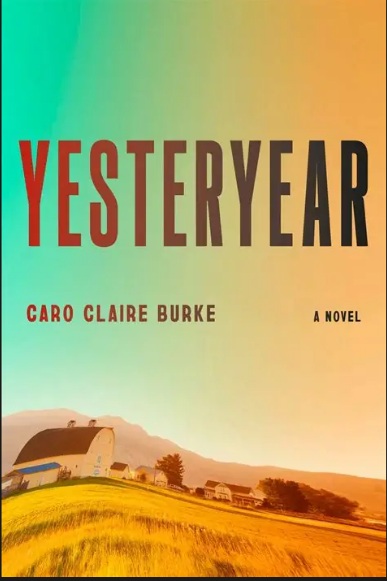
To say this book is polarizing is like saying the US is having a tad bit of trouble getting tankers through the Strait of Hormuz right now—it currently holds a 3.86 rating on Goodreads, which is relatively low for a bestselling book and reflects the fact that some 30% of readers rated it 3 or below. Why the U-shaped ratings?
I think it is because it spares neither side in the ongoing mommy-feminist culture wars. A synopsis (again, spoilers):
Natalie and her sister are raised by a single mother, a devout Christian living in an unspecified rural town in Idaho. She is very smart and earns a full scholarship to Harvard but is immediately taken aback by the licentiousness and amorality of her fellow (female) students–all self-proclaimed feminists waging war against the “patriarchy”. In addition to having no moral code, they are portrayed as liars and hypocrites, enjoying the benefits of an upper-middle-class upbringing while simultaneously railing against their parents. One of them has consensual sex with a boy and later claims she was raped. Natalie reacts to her classmates by courting, and then marrying, a fantastically wealthy senior, the scion of a powerful political family and also, according to Natalie, as dumb as post. She quickly becomes pregnant and drops out of Harvard and settles into what might be domestic bliss, except that she hates being a mother, despises the child, and considers her husband a poor lover and stupid man with no ambition, to boot. (He is actually very good with children and aspires to be a kindergarten teacher, which Natalie agrees he would be good at but quickly dissuades his ambitions because it is not “manly.”)
Brainstorming with her sinfully rich father-in-law, she hatches a plan: Overpay for an abandoned 500-acre ranch in Idaho and establish an online influencer career of selling an ersatz “frontier-tradwife-life” to millions of gullible Instagramers, which is to real farming as the Matterhorn in Disneyland is to mountaineering. Wait, what? The suspension of disbelief is almost broken here—I can buy (maybe) that she would throw away a hard-fought Harvard scholarship (it’s not Stanford, after all), but spend five million dollars to finance a fake internet scheme? Why can’t her husband teach kids? It worked for Mr. Rogers.
Let’s shove that doubt aside and continue: the scheme goes well for about a dozen years, until the crisis occurs: At this point she presides over a brood of five kids, sixth one in the oven, with two dozen laborers working the fields which are supposed to be organic but are actually the product of liberal applications of (hidden) pesticide and a dolt of a husband whose main role seems to be eye-candy for the tradwife videos she sells. She is aided by two nannies and a video producer, whose carefully edited videos make it appear that she and her husband are raising the kids and working the farm themselves.
Things come to a head when the husband sleeps with the producer. Natalie attacks her, forcing the producer to go on TV and spill the beans, while also levying assault charges.
Natalie responds as we all would. (If we were insane.) She gives up her kids to her mother and retreats to the ranch, determined to actually live the life she was faking and eschewing all conveniences invented after 1855 and many that were invented before then as well—a life roughly on a level between the slums of Mexico and Gaza, or maybe Darfur.
During this interlude, which lasts 15 years, she gives birth to three more children, for a family of six living as war refugees—the daughter (Mary) who was in her womb when the scandal broke and three more children.
The story ends when the authorities finally intervene, take the kids away, and throw Natalie in prison for child endangerment.
That’s the linear timeline, and it would be a very boring story if it were told that way. The book’s appeal is the framing device: It begins with 30 pages or so describing her life as queen of the (fake) range, which establishes the scope and magnitude of her deception, but then she wakes up in 1855 in a house similar to hers but stripped of all modern conveniences, four children she doesn’t recognize, and a husband who vaguely resembles hers but treats her like chattel. The rest of the story is told as she tries to understand how she had been transported back in time, or perhaps abducted into a reality TV show. It is juxtaposed with flashbacks that tell how she got to this point (Harvard, idiot husband, unwanted kids, fake internet show, scandal).
That is what kept me turning pages and why I think so many people enjoyed this book. The reader wants to discover the secret: Did she travel in time? Was she abducted? Perhaps crazy?
There are many plot holes, and the book could have benefited from better editing for continuity. The reader is asked to believe Natalie chose a life of penury voluntarily and has raised four kids frontier style, but at some point lost her memory and believes she was abducted, or else the whole thing doesn’t work. Timelines don’t really match up: her youngest was born with the cord wrapped around her neck, which was removed by 8-year-old Mary, except Mary is 15 at book’s end and the youngest is 10, so Mary was only five.
The house is single story except when it isn’t: sometimes it has stairs. The ranch is out in the boonies up a long dirt road between two Indian reservations, except it is also 15-20 minutes from her mother’s house.
Those niggles aside, the theme is straightforward and rather banal: Make stupid choices and end up in jail, or insane, or maybe both. It reminded me of Flaubert’s Madame Bovary, where the protagonist is the engine of her own destruction. The more interesting question is: why does she make such poor choices? I think this is why the book is so controversial, as neither the “angry woman feminist” camp nor the “trad wife” side like the answer.
She gives up a sweet ride to Harvard because she is affronted by the vapidity of her classmates and doesn’t like the life that track leads to–struggling to make it in a man’s world and giving up the joys of motherhood and family life. Her foil for this is Reena, her roommate whose character and career she predicts and dissects: Reena will struggle hard for mediocre gains, giving up a lot, and will be expected to be thankful for it. Natalie rejects her husband’s ambitions and dreams up an insane, fever dream of a fake ranch in the belief that she can avoid both the “angry woman feminist” role and the “tradwife” alternative by cosplaying a parody of the “tradwife” life, bankrolled by idiot Internet viewers.
This ends badly, and I think that is what makes readers so angry. What? Wasn’t I promised that I can “have it all?”
No. Nobody can have it all. You were lied to. Life involves compromise, which is something Natalie never learns. Reena, the feminist archetype, doesn’t seem to have done so badly. She appears at the end of the book as some kind of Diane Sawyer analogue, interviewing Natalie. She gave up things to get there, as she relates to Natalie—she has a family, just not a “traditional family” (the reader is left to wonder–cats?)
And there’s the other archetype, Natalie’s mother, who at the book’s end has raised, in addition to her own, Natalie’s five kids, plus her sister’s! Plus, one suspects, the four war-refugee children borne by Natalie in her 1855-years. What a saint!
I think the mother is the real hero of this book. She supports her children and grandchildren with quiet dignity, always there to pick up the pieces when needed.
As her mother and Reena show her, Natalie can’t have it all, but she could have had a good life nonetheless. The story is told from a woman’s point of view, but I think there is a lesson here for both men and women: yeah, it’s a hard life, and we sometimes have to do things we don’t like, but we can make a good one of it if we make the right choices. And it’s not so bad to be kind, as her mother tells her at the end.
M’lord, you must rise to defend your Kingdom from the Deplorables.
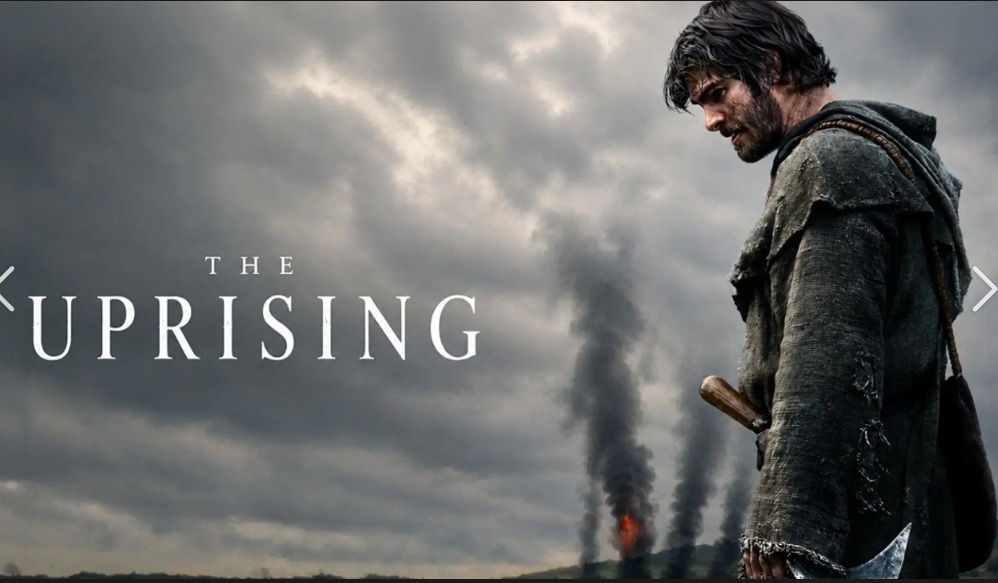
Nope, this isn’t Hillary Clinton’s aide, it is a quote from the movie that came out yesterday, “The Uprising.”
The setting: Right after a global pandemic that killed a lot of people, the nation’s leader is a feckless half-wit who has let his advisors get the country involved in countless, pointless wars overseas, bankrupting the nation and forcing them to heavily tax the only reliable and compliant workforce: the nation’s workers.
Nope, this is not a documentary of the US in 2026; it is The Uprising, a pretty-true account of the Peasants’ Revolt in 1381 England that forced King Richard to abolish serfdom (for a time at least).
After some exposition, the first scene is of government thugs extorting a poll tax from an eponymously named Plowman who lost his family in the Plague and finally snaps when he sees the government agents using the pretense of law to commit unspeakable acts (sound familiar?) He becomes a figurehead in a nascent movement in SW England and elsewhere, led by real-life historical figures Tyler Wat (a soldier returned from Europe in one of Richard’s endless wars) and excommunicated priest John Ball, who rebels against the wealth and privilege of the clergy. The movie uses them as framing devices—the farmer, the soldier, and the priest—as they lead a mob of 10,000+ peasants to the outskirts of London. They reject initial attempts by the government to shoo them off and finally force King Richard, who up to this time has been following his councilors’ advice without dissent, to parley. Richard sells out the councilors, which ends in a predictable orgy of bloodletting in the streets of London—literally pitchforks, heads on pikes, heads lopped off with axes. No cliché was left unplumbed in the shooting of this movie. This part of the movie looks exactly like what might have happened on January 6th, if certain people had had their way. That is the end of the 2nd act, ending in the False Victory. The peasants have prevailed, or have they?
Of course they haven’t. It’s not called the “English Revolution”, it’s called “the Peasant’s Revolt.” Richard betrays them, leading them into an ambush with false promises of freedom, and Tyler Wat is killed (historically, his head also ended up on a pike, although I don’t think that is shown in the movie). The ambush of the peasants is everything we have come to expect in movies that portray mass carnage—shot shaky-cam, stop-frame motion cinema-verité style, we see every drop of perfectly spherical blood as it erupts in a stream from a peasant’s neck and can watch the moment that the spark of life is extinguished in their eyes.
The plowman escapes to return to his village, which he finds burned. The scene shifts to him kneeling at his wife and children’s graves, and in this moment the plowman’s eyes change—up to this point he has wandered through the movie with a look of vague incomprehension, a “what have I done?” expression. That shifts when he puts a hood over his head (obvious reference) and pulls a kerchief across his face, and in that instant his eyes become those of a killer.
In the penultimate scene, the plowman and his band of (merry?) men ambush the King’s carriage, killing all the guards but letting the King off with a warning: you will never know peace. In a bit of irony that I can’t help but think was intentional, the King casually dismisses the emancipation letter that he had signed for the plowman. “Those are just words; they don’t mean anything.” If any of this doesn’t sound familiar, you haven’t been paying attention the last few years.
In the final scene, the Plowman’s prediction comes true: It is a shot of Winchester Castle at night, and the soundtrack is filled with Richard’s screams.
The movie is a decent-to-above-average historical flick with a message for today: Our leaders and the oligarchs they listen to (and obey) can ignore us, lie to us, and cheat us, but it comes at a cost: Once they have broken the social contract, we become outlaws. There are not enough police officers in the country to keep the peace; we do it largely out of trust that we will be treated fairly and faith in the rule of law. Break that trust, and you get a nation of Robin Hoods.
Is it a good movie? “The Uprising” is a well-told story of an oft-told tale. Its scenes are riveting, and it does not drag. All the characters are flat save the plowman and the King. The plowman, as mentioned, goes from wide-eyed innocence and justifiable outrage to a steely-eyed killer. The King undergoes 3 transformations: he starts out as an almost-catatonic waif, morphs into a champion of peasant justice, shifts to a Machiavellian betrayer, and finally, we hear him screaming in the night at the demons his actions have unleashed. 4 out of 4 stars. Not for the squeamish.
I am writing this from WriterCon in Oklahoma City, and this was something a bookstore owner said in a seminar there about getting your book into independent bookstores. He is also an author, and he gave lots of advice that had nothing to do with bookstores, including the above quote. He elaborated, explaining that if you ever watched kids play, they just create. They don’t worry about ROI or sales or views or attendance or any of a hundred things adults are concerned with in a creative task: they just make things for the sheer joy of it.
It may sound trite, but that quote really opened up my eyes and explained why I enjoy taking my grandkids to the park: everything is new to them, and they just appreciate the playground for its sheer joy, no agenda. Teeter-totters! How cool! Wow, a swing! A garbage can! Wonder what it looks like from the inside? I’m going to try to harness that outlook in my life going forward, the idea of enjoying things for their own sake, right now.
Back in the adult world, my big news this month is that the new book, “Megga Maps Handicap” (MMH) is out for beta reads! God willing, I will edit it in Oct and have it out for ARCs in Nov and publish in December.
I am working hard to get it out fast because it addresses many topics in the news today: prediction markets, cryptocurrency, AI, and financial crimes. I want it to be topical, not historical, hence the need for speed.
At WriterCon, several agents allowed pitches and did not charge for the privilege, which is rare—at most conventions you have to pay to give a pitch. So, even though I planned on publishing independently, I took a swing and pitched MMH to an agent from New York. I have received more active listening, encouragement, and empathy from my captors in the jail cells of several third-world countries than I did from this agent. She stared at me with dead eyes, and I now know what a mouse feels like when a hawk looks at it. If anything, she affirmed my conviction, learned from interactions with agents on my previous books, to publish independently. For MMH, I intend to publish through my own publishing company rather than through Amazon, to give me more control.
I had a very nice interview with Mr. Greg Keifer, who hosts a podcast where he interviews veterans, eponymously named “Ask a Vet Podcast.” He is an excellent interviewer, and you can see it here:
July was a busy month! Halfway done with the third draft of Megga Maps Handicap, and if I can keep the momentum, it will be ready for beta reviews in September. When it is, I will post the first chapter in my “Freebies” part of the website here.
Right now, that site has the notes from the lecture I gave at the Virginia Writers Club Annual Symposium held at Randolph-Macon College. I gave a talk on “Cost-effective marketing for the self-published author,” and it was well-received. You are welcome to download!
The conference really recharged my writing batteries—as I have noted before, writing can be lonely, and it is fun and helpful to meet other writers, exchange notes, learn from each other, and commiserate sometimes! Someone I learned a great deal from was Kat Caldwell, an accomplished book coach and author who gave a lecture on making a reader care about your character, and using a character’s flaws and motivations to drive the narrative. Her thoughts on it mirrored my own ruminations on the subject, but she said it much better than I would. Two of my fellow Northern Virginia Writers Club members, Melody Kramer and David Wessel, also gave lectures.
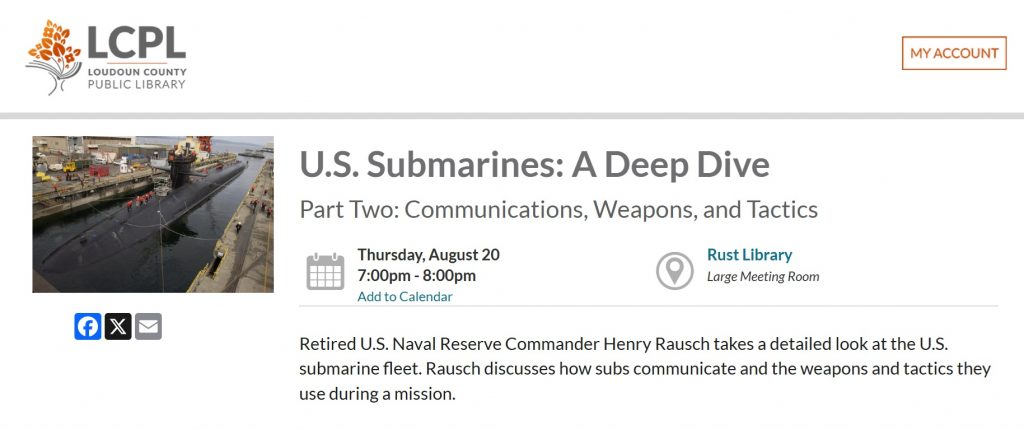
This month I will be speaking at the Rust Library in Leesburg, Virginia, on Thursday, August 20 at 7 pm. It is the second of three lectures, part of a “Deep Dive on Submarines” series. This month’s subject is Communications, Weapons, and Tactics. In July, I spoke at Cascades Library about Nuclear Power, and in September I will be back at Cascades talking about submarine operations and how subs would be employed in (God forbid) a war with China.
In July, I interviewed on the Ask a Vet Podcast, this is a long-form oral history project that interviews vets of all services and eras. I am listening to the backlog of podcasts and find them both moving and fascinating. There is a lot more history out there than is in the books; most of it is in someone’s head. Even if you already read my book, I think you would enjoy the podcast. The interviewer, Greg, has a great way of bringing a story out from his subject.