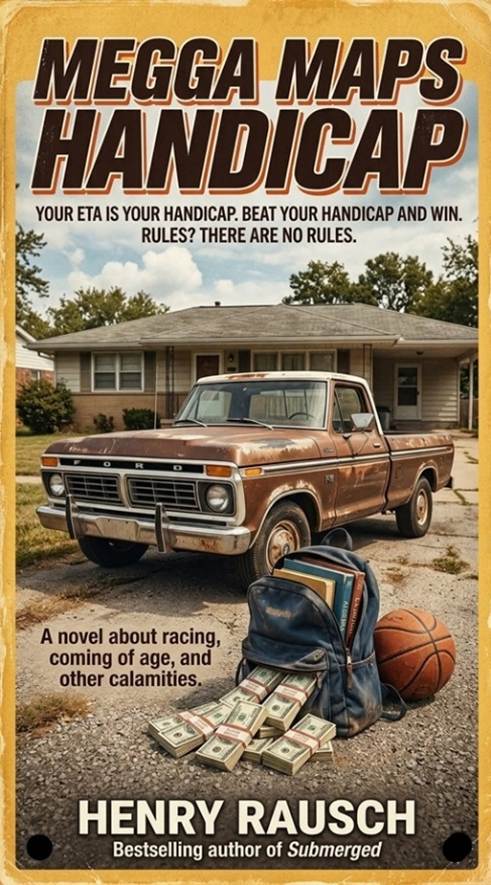
©Henry Rausch 2026
Dedicated to my mom.
“And now these three remain: faith, hope, and speed. But the greatest of these is speed.”
-Corinthians 13:13

Chapter 1: Summoned to the Trailer
US Senate Chambers, Joint Investigation Committee for Understanding the Cessation of Satellite Services (JICFUCSS)
First day of hearings, two months after the incident
Over three hundred people attended, including witnesses, spectators, and all manner and permutation of “the press”—newspapers (precious few, and getting fewer every year), TV channels, photographers, and a zoo of podcasters and other so-called journalists.
Senator William P. Holpern hefted a gavel and pounded three times on the mahogany table in front of him, then addressed the assembly: over three hundred people, including witnesses, spectators, and all manner and permutation of “the press”—newspapers (precious few, and getting fewer every year), TV channels, photographers, and a zoo of podcasters and other so-called journalists.
“This committee shall now come to order!” He glared at the crowd with dark brown eyes that dared the group to contradict him or make a sound. Satisfied that he had their attention, the senator studied the prepared document in his hands.
At seventy-three years old and a senator for twenty-six of them, the ranking member of the Senate Committee on Commerce, Science, and Transportation was at the top of his game. With a strong chin, aquiline nose, and a full head of once-black hair turned gray, he might be considered distinguished if not for a wine-colored birthmark extending from just beneath his right eye and expanding down most of his cheek that was shaped, some said, like a large tear. Rather than hurt his electability, it had helped, humanizing him with the electorate and unnerving his debating opponents, who tended to have a hard time looking him in the eye.
Confident he’d scanned the meat of the statement, he looked up at the crowd and delivered it. “This committee has been established to look into events that led up to the recent disruption—” He glanced down at his sheet, then looked up again, “some would say catastrophic disruption—of certain satellite systems in the United States, affecting not just our great nation but our allies as well.” He paused to drink from a cut-crystal tumbler. “This investigative committee is comprised of Representatives and Senators from the administration’s Party and our esteemed colleagues across the aisle.” He paused and nodded at the men and women to his right and left, then continued reading from the paper. “This committee has been convened by the authority—” Senator Holpern stopped speaking, looked up, then dramatically dropped the sheet onto the table. Leaning across it, he addressed the crowd in his trademark folksy drawl. “Well, let’s just say it was convened legally and damned fast and have done with it, shall we?”
The crowd erupted in laughter. Holpern allowed it for a moment, then held his hands out, palms down, patting the air in a gesture to quiet them.
“Ah doan’ need to tell anybody in this room how bad this event has hurt the country!” He paused a beat, looking out at the audience with steel in his eyes. “This committee will get to the bottom of what happened, an’ ah promise you! It will not happen again!” He leaned back and raised his chin, and the crowd responded as he expected, with thundering applause.
When it died down, Senator Holpern nodded his approval and spoke. “All witnesses have been sworn in and are reminded they are under oath for the duration of the hearing.” He accepted a sheet of paper from his assistant, grabbed a pair of reading glasses hanging on a chain around his neck, held them to his eyes, and began reading. “First witness is Mr. Steve Adams.”
The hearing chamber was a high-ceilinged space, arranged like an arena with seats arranged in a semicircle and descending to the chamber floor. Its focal point was the witness table, and at that table sat, alone, a thin, lanky teenager sporting an untamed brown-blond cowlick and wearing an ill-fitting suit.
Senator Holpern addressed the young man. “Mr. Adams, please tell us in your own words what caused you to create this—” he looked down at the sheet, “…this, ‘Megga Maps Handicap’?”
The young man straightened in his seat, adjusted his microphone, tugged at his collar with a forefinger in a vain attempt to loosen it, coughed, then gulped from a water bottle. He looked up at the senator. “Uh, you can call me Stick, sir. Everybody does.”
The senator nodded.
The teenager took the hint and spoke again into the microphone. “Yeah, uh, well, I realize a lot of people are upset with me right now—”
Three hundred voices erupted in laughter, hoots, and catcalls. Senator Holpern pounded the gavel. “Ah! Will! Have! Ordah!” He stared at the assembly with murder in his eyes. “Or so help me! God! I will have every swinging—uh, every single one of you! Ejected! And we will hold this as a closed hearing!” The crowd fell silent, as if by a switch. Senator Holpern turned again to the boy behind the witness table. “Son, how old are you?”
“Uh, eighteen, sir. Nineteen next week.” He fidgeted with the water bottle, then raised his head and spoke. “Uh, I guess ’mad’ is kind of an understatement. People are really angry. I get that.”
The crowd, having been warned, remained quiet. The boy turned in his seat to address them. “But it’s not all that bad, is it? I mean, life is slower now. People have time for each other. They stop and talk to each other more, if for nothing else, just to ask for directions. The political polarization we used to think would never change is gone. And I hear the students are doing better in math for the first time in two generations. Attention spans are longer. ‘Just in time’ delivery is gone now, so people reuse and recycle things. It’s better for the environment. So I just want—”
The senator cleared his throat. “Mr. Adams? Megga Maps Handicap?”
The young man turned around to face the senator again. “Yeah. I’m getting to that.” His voice took on a pleading tone. “I just want everybody to know that we didn’t plan it happening like it did!” The crowd, though cowed, couldn’t resist a collective intake of breath, a mass gasp. Stick continued. “And a lot of things that were attributed to us, we had no part in. The cross-country races, those were going on way before we invented the app. And the strippers, well, the strippers were not our idea!” He turned his head to look at the assembly again, then back to the senator. “We didn’t set out to destroy the world we lived in. All we wanted to do was run a race.”
Sterling, Virginia, ten months before the incident
A mother’s heart is nearly indestructible. It can survive childbirth, heartache, betrayal, trauma. There are documented cases of mothers in car accidents acquiring superhuman strength and lifting a vehicle to save their children trapped within. But Stick knew he’d broken his mother’s heart when he opened the envelope and she felt, rather than saw, his disappointment.
He managed a weak, insincere smile. “This is great, Mom!” His fake smile grew wider. “Thank you so much!” But it wasn’t what he’d set his heart on—Skip Barber’s Racing Fundamentals, a three-day course held at the NASCAR half-mile oval in Richmond. It was some other racing class, a knock-off, acquired at a discount through Groupon. Not Skip.
His mother made a failing attempt to mask her hurt. This was going to be a repeat of Christmas a decade ago, when she’d gotten him an off-brand set of Transformers from Big Lots, and not the brand-name ones he’d set his eight-year-old heart on. “I guess Santa’s not all he’s cracked up to be,” he had said, unaware and uncaring of the effect his words had on her. The Christmas after Stick’s father had died, she had been swamped with bills and had to take out a payday loan to afford even that, betting her car that she could pay it back before usury crushed her.
“Stevie,” his mom began. She put her hand on his. He was Stick to everyone he knew, partly because he was rail-thin and topped six feet, but also because he was a whizz at driving and all things mechanical. But he would always be Stevie to his mom.
“I know it’s not the Skip Barber class like you wanted. But you never know; this might be better. Read it.”
They were sitting at the dinette table in the liminal space that bridged the kitchen and the living area in their compact one-story, two-bedroom house. Stick had turned eighteen that summer. Mother and son celebrated the event with a pan angel cake she had baked and slathered with cream cheese frosting from a can. He hefted the letter and began reading.
Fat chance, inner Stick grumbled.
“It’s a race, Stevie!” His mother bubbled with excitement, her disappointment in his reaction forgotten. “A road rally. I looked it up on the internet. I know you’re interested in the Richmond tracks, but I thought this might be fun too.” And much safer, she added silently to herself.
“Yeah,” Stick answered without looking up, immersed in the page. Some kind of rally, apparently. A driver and his navigator competed on a road course and had to hit waypoints at designated intervals. Could actually be interesting. A wave of remorse passed through his eighteen-year-old body. Must have set Mom back a few extra shifts to come up with this. What an ass I am sometimes.
He leapt up, leaned over, and swept his mother into his arms. “It’s the BEST, Mom! Much better than Skip Barber! I love you.”
Her cheeks flushed and burned with contentment and love, accepting the lie. “Well,” his mother said, after he’d returned to his seat and she’d composed herself. “You need someone to navigate for you. I figured that—”
“You know it’s gonna be Bear, Mom.” Stick had known Bear since sixth grade. Bear lived in an affluent subdivision more than a few rungs up the socioeconomic ladder.
“Yes, I know, sweetie. I already spoke to Bernard’s mother. She knows you’re a responsible driver.”
The Mom Mafia. Knows all. Impossible to outrun. Does it ever stop, being a mom? I bet the mothers of the Apollo astronauts compared notes before the space flights. “Yeah, Mom, she doesn’t have to worry. I’ll bring her precious Bear back to her safe and sound.” He reached over the dinette table and cut the cake into squares, swiping the blade with a forefinger and licking the icing off it. “Wouldn’t do to get in an accident. Not with college coming up after senior year.”
A flicker passed over his mother’s eyes, undetectable to almost anyone, but not to her son.
“What?” He stopped licking his finger and set the knife down next to the cake with a precise, delicate movement, as if it were coated with blasting powder, not icing.
“College, Stevie.” She bit her lip. “I mean, of course I want you to go; it’s just—”
“Just what?” The tips of his ears burned, and he could feel the hair on his head standing straight up, as if his body knew what she was going to say and was preparing its defenses.
“There’s no money, Stevie,” she whispered.
A howling replaced the burning sensation in his ears, white noise that threatened to drown out his mother’s words. The icing he’d eaten turned to acid in his stomach. “The insurance settlement? The trust?”
She shook her head. “Spent.”
It felt to Stick as if he had split in two. There was a part of him still sitting at the table, listening to his mother. Another part was on an elevator with its cable cut, hurtling into an abyss. His mouth filled with saliva, and his stomach threatened to disgorge its contents across the table. He screamed at her. “Spent? That was my money! From Dad!” He looked away and uttered a plaintive murmur, almost a prayer, a whimper, a plea. “For college…”
His words had the intended effect on his mother. She flinched as if from a blow. A tear escaped care-worn eyes and made its way down a cheek that looked older than it was, with striations that circled her mouth, lines from a thousand worries. It dropped from her chin and landed on pale blue scrubs, joining a few brown bloodstains. She’d come home to celebrate her son’s birthday after working a double shift at the hospital and hadn’t taken time to change.
Stick saw the tear, and the pain he’d inflicted. “Hey—”
His mother’s voice turned quiet and low. “I love you, Stevie, but you’re an ingrate.” She brought her chin up and stared fiercely at him, rapping her knuckles on the linoleum tabletop. “What do you think pays for this, huh?” She raised and stretched her arms above her head and out, taking in the kitchen, the counter that separated it from the dining room, and the entire house. “And this? I did it all, Stevie, just you and me. Nobody to help. Don’t cop an attitude with me, young man.” Blue eyes locked onto his, daring him to look away. “The lights? What keeps those on?” She shook her head, sending locks of blonde hair swirling about her shoulders. “It all took money, Stevie. I used the settlement to keep us fed and a house over our heads.” She scooted her chair back and rose from it, leaning her arms on the table. “You don’t have a birthright to go to college. If you want to go, you’ll have to pay your own way.” She got up and walked down the short hallway to her room. As she did, she called out to him with her back turned. “You’re eighteen now. A man. Act like it.”
Stick was left in the kitchen alone, before an uneaten cake, in a spreading pool of shame and regret.
Stick and his mother lived next to Dulles Airport in Virginia, in a neighborhood where time seemed to have stood still since the sixties. Clusters of single-story starter homes branched out along meandering roads from a single boulevard that connected State Route 7 and 28. Most had been low, hip-roofed single-story structures when built, but to some, a second story had been added. Others had their garage or carport converted into an extra room. It had been a picture-postcard suburb for the burgeoning middle-class when it was created in the sixties, but time and white-flight had not been kind to it.
Most of the white population—solidly middle-class, that had built Dulles—had fled to pricier, newer suburbs in the west. They had been replaced by the new working class, mostly Hispanic. The shopping center that served as the neighborhood hub had undergone a near-death experience in the eighties. Most of the stores had shuttered but were now enjoying second and third lives in a renaissance brought about by cut-rate retail, remainder bookstores, and overstock outlets. The old cineplex had been repurposed as a laser arcade, and the windows of the smaller shops in the open-air plaza now advertised Peruvian chicken, menudo, and pupusas.
They lived on a feeder street off the main boulevard in what had been a two-bedroom bungalow that had been expanded with an extra room by converting the garage. The lack of a garage was why he was working on his truck on the cement slab, bordered to his left by a desiccated patch of lawn and to his right by his neighbor’s oil-stained slab in front of another converted garage, which now sported a compact car on cinder blocks.
Stick leaned over the engine of his ancient truck, held a feeler gauge under the #2 cylinder cam lobe, and adjusted the locking nut until the gauge slipped under the lobe with just a hint of resistance. Satisfied that the clearance was set, he gently lifted the engine cover into place over the new gasket and began the laborious process of tightening it down. He was on the last fastener when a large and wide teenager wearing baggy trousers and a sweatshirt that looked much too hot for the day appeared, walking along the cracked pavement from the direction of the boulevard.
Theodore Bernard Abrams, “Bear”, was Stick’s best friend. They had been friends since an incident in sixth grade brought them together, and the ensuing years had just made the bond stronger.
He’d been shuffling down the hallway between classes. Up to that year, students stayed in one classroom, but sixth grade brought many changes, including the requirement to move from classroom to classroom at the bell. Stick was a head taller than the other students, partly due to genes but mostly because he’d been held back a year from starting school. Hence, it was easy to see what was going on ahead of him, past the throng of students changing classes. Up against the wall with the lockers, a tall, muscular boy held a short, pudgy one by the shirt. He had the boy’s collar clutched tight in a meaty grip and was lifting the smaller child with it. The fat boy’s jowls were bright red and spilled over his collar in the older boy’s grip. He struggled to breathe, and tears brimmed in his eyes.
“Come on, Piggy! Give it up!” The larger boy gave his fist a shake, causing the smaller boy to gasp. Snot dribbled from his nose. The boy’s gasps arrived in tubercular staccatos and sounded like a chair being dragged across a floor. A cluster of students surrounded the two; their expressions would not have been out of place in a Roman colosseum.
Stick pushed his way through the crowd to face the two. A foot away from them, he could see the taller boy clutching a plastic tube with a mouthpiece in his rleft hand; he was holding it high, out of reach from the shorter boy.
The taller boy’s lips curled into a sneer. “You want this?” He waggled the inhaler. “You got to pay the fat boy tax!” The bully’s laughs sounded like a seal barking. Half the crowd joined in, tittering; the other half stayed silent, in rapt attention at the spectacle.
Stick took another step so that he was almost between the two. The short boy’s gasps had stopped. He didn’t seem to be breathing, and the red in his cheeks had become blue.
“Let him go.”
The bully turned his head and looked at Stick with an expression equal parts defiance, amusement, and hate. “You gonna make—”
It wasn’t anywhere near a good punch. Laughably easy to block. Stick balled his right hand into a fist and reared his right shoulder back, then swung his arm in a motion not unlike one would use to skip a flat stone across a pond. But the bully would have had to release the grip on his hapless victim to block it, and in any case, he didn’t expect anyone to stand up for the smaller boy. Bullies never do.
Stick’s fist slammed into the tall boy’s left temple. The boy’s cheeks fluttered at the blow, like a flag rippling in the wind. Specks of saliva flew from his mouth. His eyes registered surprise, then shock, then rolled up to the top of his head. When only the whites were visible, the boy’s grip on his victim released, and he dropped the inhaler, slumping to the floor into a crumpled, unconscious pile of meanness, spite, and evil.
The one who throws the first punch usually wins. An aphorism Stick’s dad had often said, well remembered and well used.
Hours later, Stick and his mother were still in the vice-principal’s office. The yelling and commotion that had followed the punch had long subsided, replaced by a silence broken only by the sound of the man’s pen scratching out something on a register. They sat on straight-backed chairs facing him. After what seemed an eternity, he looked up.
“You are quite fortunate the boy’s parents are not pressing charges.” He stared at Stick, who returned it with a stony stare of his own.
What does he expect? Thanks? Contrition? Obeisance?
Getting none of that, the man ran his hand from forehead to the back to pat down non-existent strands on a receding hairline. “Look, just tell me what went on. It’ll go easier on you. I talked to your teachers. It doesn’t appear you even knew that fellow. What made you stand up for him?”
Stick wasn’t going to tell the man squat. He’d had enough of the patronizing and false compassion from social workers. He sure as hell was not going to tell him the real reason. That would open up another can of worms, more ersatz demonstrations of care from fake carers, and hurt his mom’s feelings in the process. No, thank you.
It had happened just two weeks prior, in the fifth period. Mr. Carpenter was collecting permission slips for the trip to the Smithsonian Air and Space Museum, an event that heralded their new status as sixth graders and one that everyone looked forward to, not just for the trip but for the lunch and science party held at the museum cafeteria afterward.
Stick sat in the last seat of an inner row. The boy in front was called Bear. Stick had seen him around but didn’t know him. He was short, pudgy, and wore an insouciant grin permanently affixed to his face, like a birthmark. He turned around to face Stick. “Hey, dufus, you deaf? Pass your slip up.”
Stick stared down at the unsigned permission slip on his desk. His mother said she was concerned about the crime in DC, but he knew the real reason. She couldn’t, or wouldn’t, come up with the lunch fee. He was going to spend that day in the school library.
“Not going.” Stick was tempted to go with the lie, but something in the fat boy’s expression demanded honesty. “No money for the meal fee.”
Confusion, then shock, and finally annoyance wafted over the boy’s face in quick succession. “Ten whole bucks? What?”
Speaking or explaining would just add to Stick’s shame, so he stayed silent.
The boy shook his head in exasperation. “You gotta go. The whole class is. I’ll pay the damned ten dollars.”
Stick held up the permission slip. “But—”
The boy snatched the paper out of Stick’s fingers. “Easily fixed.” He laid it down on Stick’s desk and took out a pen. “What’s your mom’s name?”
“But you don’t know how to write her—”
The boy rolled his eyes. “Like it matters.” He chewed the end of his pen, closed one eye, and squinted the other at Stick’s face. “Eleanor. I bet she’s an Eleanor.” He bent over and “E Adams” appeared in a scrawl at the bottom of the sheet. Then he turned around and passed it, along with his own, to the boy in front of him.
Stick wasn’t about to tell the vice principal any of that. He wasn’t going to beg for mercy. Let him do his worst.
His worst turned out to be a week of suspension. It would have been more, but he was cut some slack owing to the fact that several years before, a gust of wind had caught the crane his father was operating and drifted it into a high-tension line, sending 50,000 volts through the man’s body, killing him instantly.
When he returned to school, Stick and Bear became inseparable. They complemented each other. Nobody messed with Bear when Stick was around. Bear admired Stick’s bravery, the ability to focus on a task and carry it out, even though he was scared. Stick admired and, to be honest, envied Bear for his money and the easy life it granted. Money opened up doors for Bear that were closed to Stick. Bear acted as if the rules didn’t apply to him because, well, they usually didn’t. Students who got free lunches were required to queue up last in line. After what became known as the “Rocky Incident”, Stick always queued with Bear at the front, and no one objected. It was Stick’s first introduction to the access and privilege money provided. He made a vow that he would become rich one day.
“Getting this heap ready for Antiques Roadshow?” Bear peered into the engine compartment.
Stick laughed and slipped the torque wrench off the bolt. “Did you walk all the way over here, fat boy? Trying to work off those Snickers bars?” He straightened up and turned to Bear. “You’re blocking my light!”
Bear shrugged unselfconsciously. He’d been given a new Chevy Cruze when he had turned sixteen, which he had promptly wrecked. The replacement was a used Mazda 3. “Pops grounded my ride til I bring my grades up. As if any of that crap matters. I’m gonna be the next Steve Jobs with my apps.” He reached into the kangaroo pouch of his sweatshirt and clawed out a Payday bar.
“Apps, apps. How many have you made, a dozen? Any of them pay off?” Stick wiped his hands and gave the engine compartment a final once-over for tools and missing bolts, parts. Satisfied, he let the truck hood down, and it locked with a double “clunk-clinch” of the locks.
“Fourteen. But who’s counting? Only takes one.”
There were a lot of things Stick admired about Bear. His genius at coding. His faithful friendship. Bear was generous, affable, and never shied away from a dare. But above all, Stick admired Bear’s unflappability. He had once watched Bear give an entire performance at his school’s rendition of “The Merry Wives of Windsor” as Falstaff. All the other players had memorized their lines, but Bear had read his from crib notes, with no apparent shame or embarrassment. It would have killed Stick to do that.
“What’re you tuning up this old heap for?” Bear munched on his candy bar, crumbs dropping onto his sweatshirt and the ground, unheeded.
Stick got in the driver’s seat, started the engine, and ran up the revs, rewarded with the sweet sound of 12 valves opening and closing on time, with none of the tapping that had caused him to adjust the valve clearances. He brought it down to idle and yelled out the open window. “A race!”
Bear mock-coughed and made a show of waving non-existent fumes away from his face. “Turn that thing off before you asphyxiate both of us!” He laughed and crumpled the Payday wrapper, stuffing it into his kangaroo pocket. “A race to the junkyard, you mean?”
Stick unlimbered from the cabin, shut the driver’s door, and patted the truck’s hood. “Don’t pay any attention to him, baby. He’s just jealous.” He turned to Bear. “Well, kind of a race.” He reached through the open window and grabbed a stack of papers, handing them to Bear. “My mom got it for me. It’s not Skip Barber, but it still looks interesting.”
Bear took the papers, wiped a caramel-smeared hand across his belly, and read them, shuffling through the stack quickly. “Not a speed race,” he said without looking up, moving one sheet on top of the other. “Time-Speed-Distance Rally. I’ve heard of these. You have to hit your marks on time on a road course. Sometimes a nice purse at the end.”
The mention of a purse grabbed Stick’s attention. “How much of a purse?”
Bear pulled another candy bar from his pouch, unwrapped it, and began chewing, contemplating the papers. “Dunno. That’s horsey country. Rich folks. Robert Duvall lived there, the movie star. Probably juicy.”
Juicier the better, with that revelation about the trust fund last night.
Bear looked up at Stick. “You think you can navigate this?”
Stick smiled. “That’s where you come in. I’ll drive. I need a navigator. All you have to do is read the map. Think you can do that, Bear?”
Bear snorted. “You’ll be my chauffeur, you mean. Yeah, I suppose I could navigate your road rally for you. Too bad about Skip, though.”
A cloud passed over Stick’s gray eyes for a moment. Strong as their bond was, the gulf between their circumstances was wide. Bear never seemed to notice how easy his dad’s money made his life, and he lived with an implicit assumption that it was as easy for everyone, unaware of how entitled he was. Like a fish doesn’t notice water. “Yeah, well. Time for that later.” He brightened. “Think you can navigate good enough so we hit our marks? Maybe, I dunno, place? Win, even?” How juicy is that purse?
Bear stuffed the sheets into his kangaroo pouch. “I’ll navigate us to first place. As long as you can drive that heap like I tell you.”
Stick got back in the truck, started the engine, pushed in the clutch, and put the gear shift through its paces. He hollered out the window, “Get in! Let’s give this a run to make sure the tappets are set!” He pressed the gas pedal and listened to the symphony produced by a well-maintained reciprocating engine turning at 3500 rpms. “And yeah, Bear, if it has wheels, I can drive it. I’m Stick, remember?”