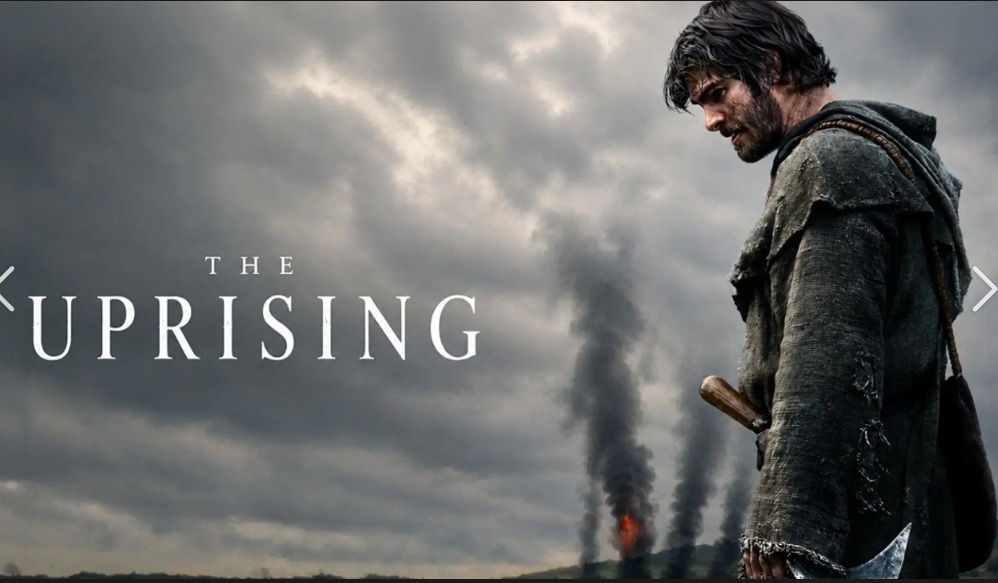
Review of “The Uprising” Sep 12 2026
M’lord, you must rise to defend your Kingdom from the Deplorables.
Nope, this isn’t Hillary Clinton’s aide, it is a quote from the movie that came out yesterday, “The Uprising.”
The setting: Right after a global pandemic that killed a lot of people, the nation’s leader is a feckless half-wit who has let his advisors get the country involved in countless, pointless wars overseas, bankrupting the nation and forcing them to heavily tax the only reliable and compliant workforce: the nation’s workers.
Nope, this is not a documentary of the US in 2026; it is The Uprising, a pretty-true account of the Peasants’ Revolt in 1381 England that forced King Richard to abolish serfdom (for a time at least).
After some exposition, the first scene is of government thugs extorting a poll tax from an eponymously named Plowman who lost his family in the Plague and finally snaps when he sees the government agents using the pretense of law to commit unspeakable acts (sound familiar?) He becomes a figurehead in a nascent movement in SW England and elsewhere, led by real-life historical figures Tyler Wat (a soldier returned from Europe in one of Richard’s endless wars) and excommunicated priest John Ball, who rebels against the wealth and privilege of the clergy. The movie uses them as framing devices—the farmer, the soldier, and the priest—as they lead a mob of 10,000+ peasants to the outskirts of London. They reject initial attempts by the government to shoo them off and finally force King Richard, who up to this time has been following his councilors’ advice without dissent, to parley. Richard sells out the councilors, which ends in a predictable orgy of bloodletting in the streets of London—literally pitchforks, heads on pikes, heads lopped off with axes. No cliché was left unplumbed in the shooting of this movie. This part of the movie looks exactly like what might have happened on January 6th, if certain people had had their way. That is the end of the 2nd act, ending in the False Victory. The peasants have prevailed, or have they?
Of course they haven’t. It’s not called the “English Revolution”, it’s called “the Peasant’s Revolt.” Richard betrays them, leading them into an ambush with false promises of freedom, and Tyler Wat is killed (historically, his head also ended up on a pike, although I don’t think that is shown in the movie). The ambush of the peasants is everything we have come to expect in movies that portray mass carnage—shot shaky-cam, stop-frame motion cinema-verité style, we see every drop of perfectly spherical blood as it erupts in a stream from a peasant’s neck and can watch the moment that the spark of life is extinguished in their eyes.
The plowman escapes to return to his village, which he finds burned. The scene shifts to him kneeling at his wife and children’s graves, and in this moment the plowman’s eyes change—up to this point he has wandered through the movie with a look of vague incomprehension, a “what have I done?” expression. That shifts when he puts a hood over his head (obvious reference) and pulls a kerchief across his face, and in that instant his eyes become those of a killer.
In the penultimate scene, the plowman and his band of (merry?) men ambush the King’s carriage, killing all the guards but letting the King off with a warning: you will never know peace. In a bit of irony that I can’t help but think was intentional, the King casually dismisses the emancipation letter that he had signed for the plowman. “Those are just words; they don’t mean anything.” If any of this doesn’t sound familiar, you haven’t been paying attention the last few years.
In the final scene, the Plowman’s prediction comes true: It is a shot of Winchester Castle at night, and the soundtrack is filled with Richard’s screams.
The movie is a decent-to-above-average historical flick with a message for today: Our leaders and the oligarchs they listen to (and obey) can ignore us, lie to us, and cheat us, but it comes at a cost: Once they have broken the social contract, we become outlaws. There are not enough police officers in the country to keep the peace; we do it largely out of trust that we will be treated fairly and faith in the rule of law. Break that trust, and you get a nation of Robin Hoods.
Is it a good movie? “The Uprising” is a well-told story of an oft-told tale. Its scenes are riveting, and it does not drag. All the characters are flat save the plowman and the King. The plowman, as mentioned, goes from wide-eyed innocence and justifiable outrage to a steely-eyed killer. The King undergoes 3 transformations: he starts out as an almost-catatonic waif, morphs into a champion of peasant justice, shifts to a Machiavellian betrayer, and finally, we hear him screaming in the night at the demons his actions have unleashed. 4 out of 4 stars. Not for the squeamish.