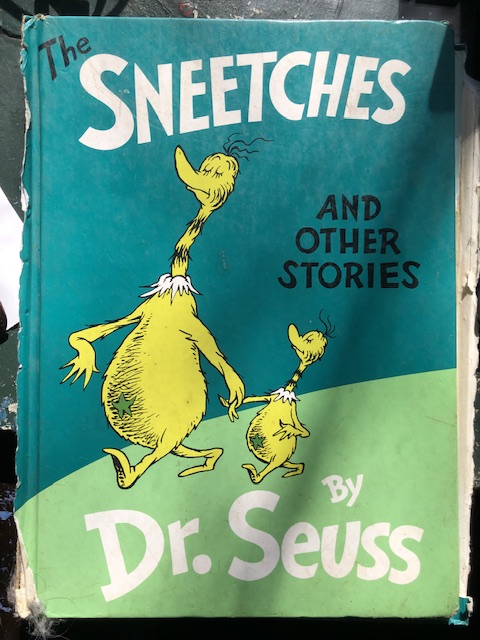
Pity the Sneetches without stars on their bellies. They are excluded from the company of the Sneetches with stars, who walk around all snooty and smarty, not inviting them to their frankfurter parties. Then Sylvester McBean arrives with a fix: a “Star-on” machine, which allows them to associate with their star-belly brethren. They are naturally incensed. McBean addresses their angst with a “Star-off machine,” and pretty soon all the Sneetches are running through each machine every few minutes in an effort to keep up, until they are bankrupt. McBean drives away with all their money, yelling, “You can’t teach a Sneetch!”. But in Dr Seuss’s tale, the Sneetches do learn their lesson and live in harmony afterward.
We writers aren’t as smart as the Sneetches. Silicon Valley stole our copyrighted material to create writing algorithms that are convincing enough to blur the lines between human-generated work and AI. Just like McBean, they “fixed” it by creating an “AI detector”—Pangram and others. And just like McBean, they addressed the “AI detector” by selling us an “AI detector-fooler”, called a “humanizer” in some circles.
Are we going to act like Sneetches, sending all our money to the AI overlords in a continuous AI/AI detector/AI fooling loop until we are broke?
Here’s another way. The reason Pangram can get away with what is essentially a shakedown (nice manuscript you have there kid, be a shame if somebody labeled it AI) is that the term is a bogeyman, completely undefined. Depending on who you talk to, it can range from using spell check to having an LLM create an entire story based on a prompt. What does it mean for Pangram to label something “31% AI?”
To fix this, and stop Pangram in its tracks, I propose much more granular self-disclosure and labeling of content, along the lines of FDA content rules for food. We all buy different kinds of food–prepared, processed, fresh, organic, and we trust that food because we trust the labeling. There is a range to AI which a facile “31%” does not describe. Off the top of my head, from least to most, I would create a ranking like this:
Spell/grammar/syntax/checkers
Non-generative Copy and line Editing tools that identify weak prose but do not change the text—use of passive tense, awkward construction, run-on sentences, overuse of adverbs, repeats
Generative Copy and line Editing tools that act as above but also suggest alternative prose/language. (Personally, this is where I draw the line; I am fine with anything an editor would flag, e.g., “that sentence is passive”, but I will never accept a rephrase from a program.)
Structural editing tools that identify plot holes and weaknesses—again, this would be divided into generative and non-generative use.
Researching: this is a gray area that I am wary of using myself; I have seen “research” output that would be very easy to turn into prose, but I am not judging anyone who uses it
At the far end of the scale, pure generative AI where a story is created by a prompt.
This scheme could be based on voluntary disclosure, just like the grocery store. It could be coupled with penalties for abuse, in both directions: non-disclosure of use of a category, and also defamation –accusing a writer of using AI without proof (looking at you, Pangram).
Besides the food industry, there is precedent for a standards-based, self governing body setting defined protocols– the computer industry. It uses “RFCs” (Requests for Comment) which define interfaces and routines, all voluntarily reached by consensus of an industry group.
The alternative is to let Silicon Valley control us, with AI, AI detectors, AI detector-foolers, and so on. Let’s let them know we are not Sneetches, and we aren’t going to play their game.