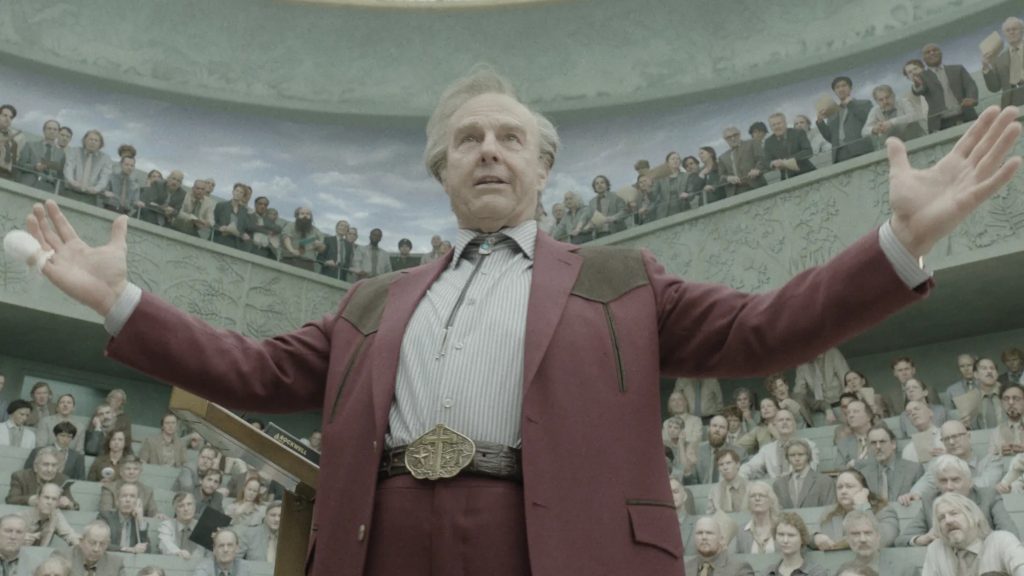
An oil baron lives in a mansion filled with stuffed dead animals and a barely living cat, which he dotes over. Receiving word of the dangers of drilling in Alaska and Greenland, he dismisses his engineer’s concerns with a “drill, baby, drill” mantra. It is only when the Greenland site blows up, sending a chunk of ice the size of Rhode Island toward Europe, where it will cause flooding that will kill hundreds of thousands, that he even shows concern—over his drilling rig. He quickly calls the President of the United States, who he has on speed dial and whom it is apparent that he controls. Another day in the life of an oil mogul? Nope, this is the setup for “Digger”, a farcical satire starring Tom Cruise and John Goodman doing their best to out-ham each other.
To explain this movie, and why I think it is worth seeing, I need to reveal two spoilers: The first is we are watching a play, which doesn’t become evident until Digger (Tom Cruise) misses a line in a scene with the president (John Goodman) and they break character, and the camera rolls back to reveal the set, with stagehands running around setting the scenes. So far, so Adam McKay, he of “Don’t Look Up” fame, a transparent, tone-deaf screed about global warming. The second spoiler is more subtle and jarring. For reasons never made clear, the rogue iceberg is named “Judy” and in a scene of the play within the movie, a character mentions “Judy” like it was a real event in their world, not in the play. What?
The big reveal is that the play is in fact a comedy satire, but not of the Adam McKay warning variety—it recounts historical events where the Digger character and the President ended up on Air Force One and destroyed another, bigger iceberg, which unleashed both radiation and flooding that didn’t quite destroy the world, but almost.
There are two great monologues in this movie. The first is Tom Cruise’s Digger, in a speech to a cage match of a United Nations where he admits that he enriched himself beyond measure by drilling for oil, but in a scene of uncharacteristic self-reflection for an Adam McKay type movie, he points the finger at them. You hypocrites, he rails. Oil has given you the easy life where you can overnight-order crap you don’t need, live in air conditioning, and travel where your whims dictate. How many of you bicycled or walked here? he asks. I cheered at the character in the scene. I am so tired of listening to sanctimonious NPR and PBS hosts natter about “human-caused global warming”. First of all, there is a correlation between CO2 and a warming climate, but not a causal one. Second, if they really believed CO2 were the cause of the warming, why would they live such profligate lives? I would bet every single one of the presenters blabbering about “human-caused global warming” has a CO2 footprint one hundred times mine: I live in a small house that is easy to heat; it costs about $400 a winter in West Virginia for heating bills, with no air conditioning. Digger’s speech, taking these “limousine liberals” to task for flying private jets to climate control conferences (I’m looking at you, Al Gore) is the reason that this movie has been panned and damned with faint praise by the intelligentsia—it hits the hypocrites of the global warming fear-panderers too close to home.
The second great monologue is Jesse Plemons, who portrays the play’s producer. He intervenes when the character playing Digger in the play (Tom Cruise) has a row with the play’s manager. “You’re both right. But we need to set this aside and get on with it.” He is talking about the play, but he is actually talking to both sides of the current global warming debate. “It doesn’t matter who’s right, he pleads. I just want the play to go forward.” Likewise, the Earth is experiencing dramatic weather changes regardless of whether, or to what extent, they have been caused by human-produced CO2, and we need to deal with it anyway. Another reason the movie won’t do well, I think—nuance and balance don’t play well these days.
The movie’s ending is nothing less than shocking. There are intimations that the events depicted in the play have changed the climate, but these don’t prepare you for the ending. The penultimate scene is right out of any West End or Broadway night, actors slapping each other on the back, taking bows to the audience, who are cheering madly. But as the camera pans to the audience, they are shown sweating copiously. An alarm sounds, everyone dons breathing masks, the door opens,and they exit into a hellhole of a New York that makes the Blade Runner set look like a tropical paradise. This is the world we have wrought—not just Digger, but all of us.
I really enjoyed this movie. Cruise’s monologue to the barbaric-UN is worth the price of admission alone. There are a few monologues that I loved so much I memorized—Henry V’s speech before Agincourt is one, Tony Montana’s drug-addled restaurant rant in Scarface is another. This might be a third.