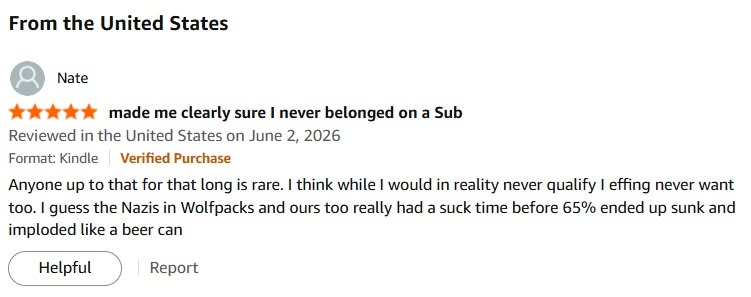
I get many reviews on Submerged—approaching 2000 now in Amazon and Goodreads combined- and I appreciate all of them, but I especially loved this one. Nate, wherever you are, you sound like a man of wisdom and judgement! This was posted in June, and the entire month, whenever I needed a laugh, I went back and read it.
This month, I attended the West Virginia Writing Club’s annual meeting in Ripley, WV. Writing can be a lonely business, so it is especially helpful to meet with other writers “IRL.” It was a three-day symposium with talks by established writers. The session I found most useful was “Floaty-Groundy” by Brad Barkley. He is a prolific and well-regarded author whose latest book was just published, “The Reel Life of Zara Kegg”, which I intend to read when my TBR stack supports it. He read an excerpt at the conference and it really hooked me.
“Floaty-Groundy” is a riff on Helmuth Von Moltke’s theory of officers. He divided them into four groups based on intelligence and industriousness. Lazy, smart officers were best for command; they found the most efficient solutions. Industrious smart officers made the best staff officers. Lazy dumb officers were useful for menial work, but beware the industrious, stupid officers! They would get you into trouble!
In Barkley’s literary version, you can have a character who is grounded—has a definite goal-or “floaty”, has no explicit goals or amorphous ones. Plots can be grounded, with a definite timeline that drives a plot (the bomb will go off in 60 minutes), or “floaty”, with nothing specific driving it. With that taxonomy, you can categorize works of fiction. “Groundy Groundy” novels are thrillers: the hero has a goal, the plot is driven by a timeline. “Floaty-Groundy” novels tend to be more literary; the hero does not have a specific goal or cannot articulate one, but nevertheless he grows over the course of the story, which is driven by a grounded plot (Scarlett in Gone with the Wind, the protagonist in Idiocracy). In “Groundy-Floaty” stories, the hero has a goal, but there is nothing specific driving the plot—the Dude in The Big Lebowski, and the protagonists in Moby Dick and Jaws—the big fish could just swim off and disappear; it is a “floaty” plot.
But beware “Floaty-Floaty” stories, where the hero does not have an explicit goal and the plot is not driven by a timeline! Those tend to meander. Think Holden Caufield in Catcher in the Rye—no goal, no driven plot. Or the protagonist in Prince of Tides. That taxonomy resonated with me, and I immediately recognized that the novel I am working on now is “Floaty Groundy”- Stick has an inchoate goal of “not being poor” (floaty), but the plot is driven inexorably by a race that if allowed to be run, will destroy the world (groundy). Speaking of Megga Maps Handicap, I should have a draft ready for beta review by September and am shooting for having Advance Reader Copies (ARCs) out by October, and to have it published before the end of the year.
On Thursday, July 30, at 7 PM, I am giving a course on Nuclear Power and Life Support on submarines at Cascades Library in Loudoun County, Virginia. It is free and everyone is invited and promises to be exciting. It is based on a series of classes I gave at George Mason University last year and this year.
Until next month, peace.