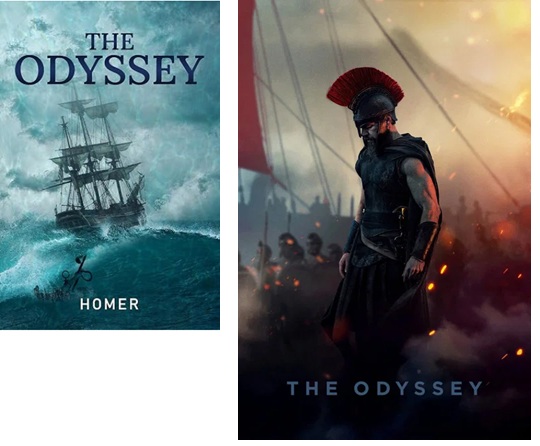
Full Disclosure: I’m an Odyssey junkie. Read it more times than I can count and sailed and traveled to all the places in it—Cape Circeo (Aeaea), North Africa (Cicones), the pillars off the Amalfi Coast (Sirens), the Strait of Messina (Scylla and Charibdis), Sardinia (Laestrygonians ), the Strait of Gibraltar (Hades), and of course Troy itself. I read it to my daughter so much when she was young that Odysseus’s line to Circe “How can I love you when you’re turning my men into pigs?” became an inside joke with us, not the least because, even at a young age, she understood that the line between men and pigs can be a fine one, easily crossed. So, of course I had to see this movie the day it came out, and of course I loved it and recommend it highly, but that would be a boring and useless review.
Instead, I will give you a critical evaluation from someone who loves the story—where it deviates from the poem, what Nolan chooses to highlight instead of other story elements–in the hope that you will enjoy the movie more when you see it. Which you should.
The biggest difference between the poem and Nolan’s interpretation of it is Odysseus himself. The poem is a story of a man trying to get back to his wife after a long war. Along the way, he is waylaid by seductive women and misadventures that are partly the result of his own mistakes and partly caused by his men doing stupid things. Yep, it is the Ur-sailor story, and it is not a coincidence that in my memoir I name my wife ‘Penelope’ and at the end of the book, upon finally being reunited with my son who was born while I was at sea, I half-jokingly suggest we call him ‘Telemachus’.
This makes for a rousing, entertaining story by itself. The thing that makes the story captivating and eternal is that Odysseus invariably chooses to think his way out of a situation, rather than fight. Many military officers secretly identify with him for this reason. Mentor relates to Telemachus his father’s motto in the movie when he says, “You’re not always going to be the fastest or strongest, so try to be the smartest.”
Nolan gives us a deeper interpretation. His Odysseus is haunted by what he did in the war, which amounts to war crimes in his mind. At the end of the movie, he confesses to Penelope that he took ten years to return to get his head right about what he did, that he didn’t feel worthy of her love before he had redeemed himself. It’s a truism that movies are about the current times, and nowhere is this more true than in Nolan’s interpretation. At some level, we, like Nolan’s Odysseus, fear that we have crossed the boundary of acceptable human behavior in recent wars (take your pick: Afghanistan, Iraq, Iran, machine-gunning the survivors of a drug boat), that we have unleashed the forces of darkness and the civilized world is on the brink of being torn asunder. In Nolan’s work, the two interrelated themes are that the Greeks have defied “Zeus’s law” and consequently give the ‘Sea Peoples’ full right to destroy civilization. Odysseus, particularly, is consumed by guilt from having transcended a basic Bronze Age convention—he left a peace offering that was accepted as such and brought within Troy’s walls and thus sealed their doom.
Nolan’s interpretation catapults the movie from a great “toga and sandals” flick to a deeply contemplative work that will haunt your days and nights long after you leave the movie theater.
Now let’s take a look at the nits and address the pedants. He omits the sack of Isamus, probably for time’s sake, and the losses they take in their pillaging are made clearly enough in other scenes. He concatenates the island of lotus eaters with Odysseus’s time with Calypso, and uses the memory-obscuring properties of that drug as a plot device to explain why he remains with her for 8 years.
His men never open the bag of Aeolus’s winds, which, combined with Odysseus’s prideful taunt to Polyphemus, is the inciting event that sends Odysseus on a ten-year adventure and the men to their doom. I think this omission is deliberate. Nolan carefully cut out anything overly supernatural. Releasing Aeolus’s winds would have made it a different movie. Similarly, Nolan changes the scene with Polyphemus. In the poem, Odysseus pridefully boasts to the cyclops that he, Odysseus! was the one who blinded the giant, thus inciting Poseidon’s wrath and setting the stage for the trials that follow. In the movie, Odysseus quite unnecessarily nicks the blinded giant with an arrow, and Poseidon’s rage happens “off camera”. In Nolan’s take, the gods aren’t the cause of the men’s tribulation; the men have themselves to thank for that, combined with Fate. In that respect, it is a very Stoic interpretation.
Circe is more of a witch and not as hot as I remember her, and the year that Odysseus spends in her arms is reduced to an afternoon, probably for timing reasons.
The Laestrygonians destroy all but one of Odysseus’s ships, but instead of there being 10 as in the poem, there are only three. Obviously a choice made to cut production costs, and I am grateful Nolan did—otherwise, the movie would have been an MCU-like cartoon of CGI. In this movie, all the ships you see really float on real water.
Calypso, played by Charlize Theron, is every bit as hot in the movie as in the poem, and you can definitely understand why Odysseus would spend 8 years with her. But in the poem, it is Zeus who tells her she had to let Odysseus go. In the movie, she comes to that realization herself. Again, Nolan avoids anything overtly supernatural.
The casting of Zendaya as Athena was brilliant. In the poem, she is supernatural, but in the movie, she is the embodiment of the crushing, debilitating guilt Odysseus feels for his part in the war. She is an apparition of a girl killed in the sack of Troy, for which he is personally and directly responsible. When he finally forgives himself, she disappears. I cried at that scene; it is the most powerful in the entire movie. Odysseus confesses and finally forgives himself, and Penelope accepts him, war crimes and all.
One nit I have about Helen: Much has been written about the choice of a black actress to portray her. I completely disagree; she was perfect for the part. Funny how a reviewer can accept a fifteen-foot cyclops but object to a black Helen. Except. The actress (Lupita Nyongo) is beautiful, and in the Iliad, that beauty will indeed launch a thousand ships. But in the poem version of the Odyssey, she is a staid and dutiful housewife, complacent and compliant, back in the fold of Menelaus’ household. Her wild-child days and her beauty are in her past. When I think of Helen in the Odyssey, I picture Barbara Billingsley.
Penelope, played by Anne Hathaway, is every bit the match for Odysseus—wily, outsmarts the suitors, takes no crap. As when he remonstrates her son, “Hey genius, who do you think has been running this place for twenty years! We need a king…why, exactly?” I cheered inside at that line. Yep, she definitely reminded me of my wife.
(The movie carefully omits, however, the fact that Penelope is responsible for Odysseus going to Agamemnon’s war in the first place. He had a plan to get out of it; she spoiled it by bringing baby Telemachus down to the beach that day.)
The ending: Not gonna spoil it, and I did like it, but if you want a different take, check out Madeline Miller’s Circe, which has a more believable, and I think fitting, end for Odysseus.
Nolan’s Odyssey is a redemption story of a man learning to forgive himself through trials.
His Odysseus is both the best and worst of us—smart, charismatic, loyal but also prideful, ruthless, and given to acts of rage. Noland gives us a lot to think about as we leave the theater.
NB: If after watching the movie you want another story about a man who can’t forgive himself for acts he committed in the war and undergoes trials which finally result in his redemption, check out my book, How to Hotwire an Airplane. The war is in Vietnam, and the trials involve flying illegal immigrants over the border patrol, but it has the same theme. I think you will like it.