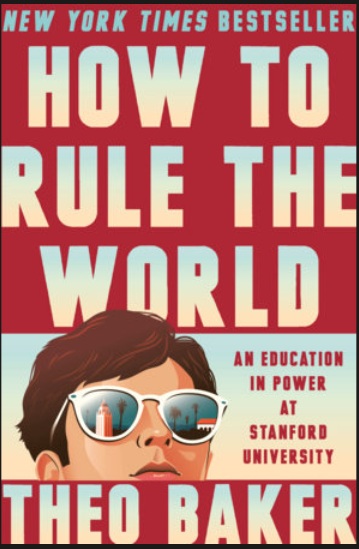
Theo Baker must need a wheelbarrow to carry his testes around; I cannot imagine him standing up to Stanford as he did at any time, much less as a 17-year-old freshman. “How to Rule the World” is both a memoir of his freshman year and a dissection of the amorality that plagues his alma mater, told through the lens of his investigative reporting on the college newspaper (Stanford Daily). As a freshman reporter, he investigated and published reports about irregularities in the university president’s research into Alzheimer’s while that man was a scientist at Genentech, which led to his resignation.
The book jumps between scenes of campus life post-pandemic, post-MeToo, and apparently post-fun, juxtaposed with accounts of him tracking down a lead, interviewing contacts, being threatened by the president’s lawyers, and ultimately being vindicated. The dual narrative is choppy in spots, but the story does not drag and toward the end I read the rest of the book in a 5-hour sitting; it was that gripping.
That’s the external story of the book. The internal story is about a university that has become rich and sated, grown into a juggernaut with cash reserves larger than most nations, and along the way has lost its soul. Scenes abound in the book of undergraduates offered in one sitting more money than most of us see in our entire lives, of wild drug- and booze-fueled parties on chartered yachts and posh enclaves of the ultra-rich in the hills above Stanford. Contrasting these scenes is Theo, who is a bit overwhelmed by the wealth and greed of the place, and seems to wish for the old Stanford, before it became a brand and a symbol for wealth that transcends morality.
I attended the old Stanford,79-83, graduating in ‘ 83 with a BS in Chemistry. I get the impression Theo would have liked it more than the one he attended—it had all the amorality and twice the licentiousness. My house, Terra, used to give “Reefer Madness Parties” where students watched that 1936 classic about the dangers of drugs for laughs, while scarfing munchies and smoking dope (paid for with dorm funds.)
At the first football game I attended, the halftime theme was “A Tribute to Watery Death” with the band enacting first the sinking of the Titanic, to the tune of Foreigner’s “Cold as Ice”, then the death of Mary Jo Kopechne at Chappaquiddick, to the tune of Santana’s “She’s not there.” One house held an annual “Pimp and Prostitute Party”, where a not-insignificant number of couples reversed roles, with the guy dressed as a hooker and the girl outfitted with a felt fedora and purple greatcoat. You get the idea.
The old Stanford had all the amorality of the new, but it was a warehouse of dry-as-leaves diplomas waiting for a match. The torch was the internet boom, followed by cryptocurrency, and now AI, filling its coffers with wealth beyond the dreams of Croesus. The wealth and prominence that came with it burned down Old Stanford, setting the stage for the scandals that inevitably follow when the morals of a toddler are combined with the cash reserves of a portion of the OECD- Sam Bankman-Fried, Elizabeth Holmes, and now March Tessier-Lavigne. So, it’s a bit of a sad read; Theo helps take down the university president while mourning the Stanford he never knew. Excellent read and recommended for anyone who enjoys coming-of-age memoirs and true crime novels.